Cambridge City Council hosted a free screening of the People’s Emergency Briefing film at the Guildhall on Friday 25 September, welcoming over 350 residents to hear about local projects to tackle climate change and help Cambridge adapt to its impacts.
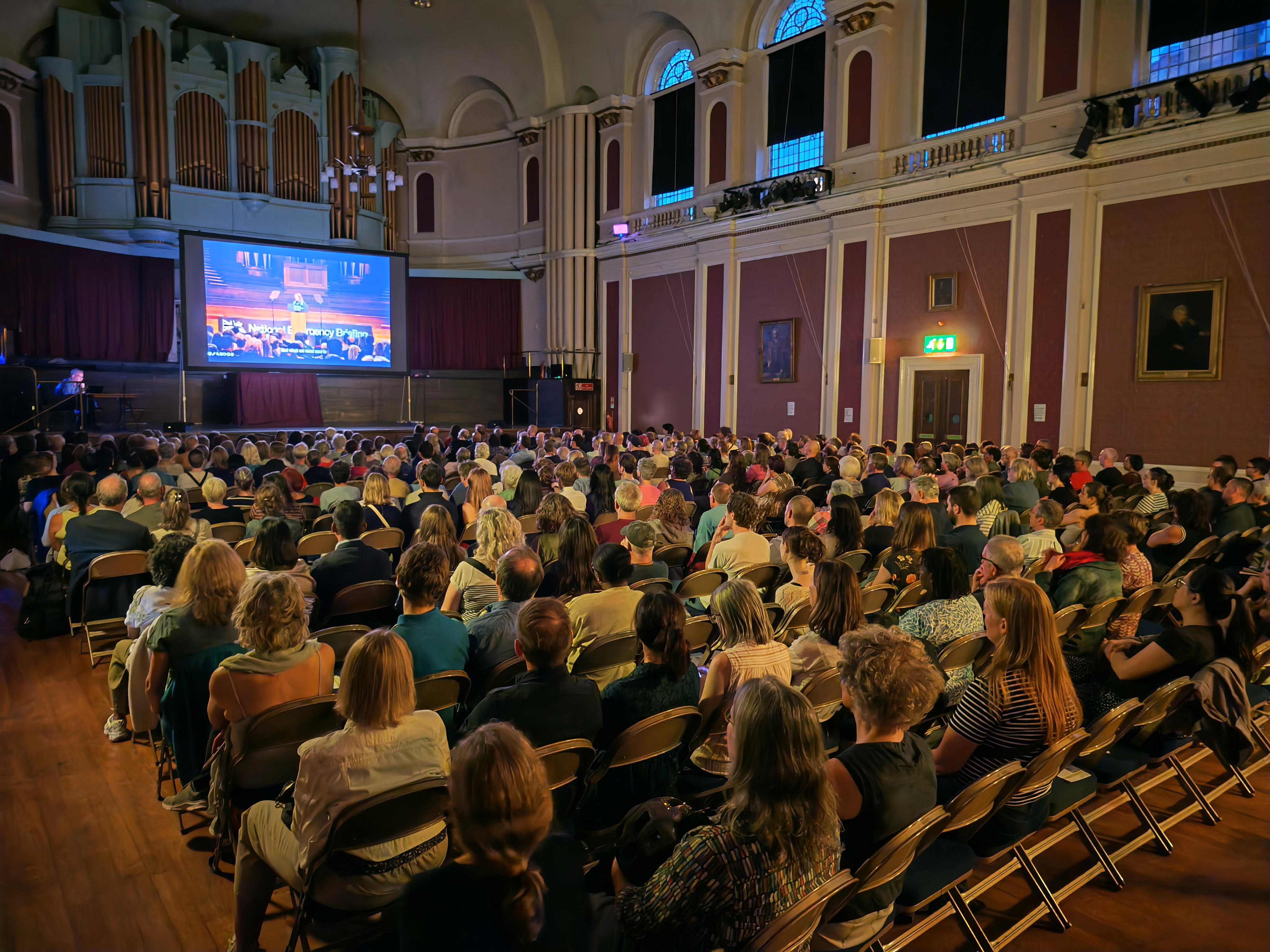
The award-winning film provides an evidence-based explanation of the climate crisis, exploring its effects on health, food security and the economy. Attendees also heard about the council’s ongoing work to address climate change and support communities in adapting to challenges such as flooding, overheating and sustainable food provision.
Tackling climate change has been one of the council’s key priorities since 2007, and the council declared a climate emergency in 2019. The council’s own greenhouse gas emissions have been reduced by 51.9% since 2014/15, while emissions across Cambridge have fallen by 47.3% since 2005.
In March 2026, Cambridge City Council updated its Climate Change and Biodiversity Strategies, supporting the wider city to reach the net zero vision from its own operations by 2030 and supporting the wider city to reach net zero. The council also remains committed to achieving 20% biodiversity net gain on council-led developments and creating more joined-up nature across the city.
The council is also working to protect and enhance chalk streams through the Greater Cambridge Chalk Stream Project, while its Urban Forest Strategy sets out plans to restore, protect and grow Cambridge’s tree canopy, with a target of 20% coverage by 2050.
Cllr Rosy Moore, Deputy Leader and Cabinet Member for Climate Action and Environment, said:
“After the hottest summer on record, it was very encouraging to see people coming together to learn about climate change, what can be done to reduce its effects and the action we’re taking locally.
“While individual action matters, tackling climate change is a shared responsibility. Councils, governments and organisations all have a role to play, and in Cambridge, we’re continuing to act and support communities in preparing for the future. We are also working with a wide range of partners to cut our own emissions as a council, which you can find out about in our current Climate Change Strategy.
“Every action we take today makes a difference for the future, whether that’s bringing down energy bills for our current council tenants and those moving into our new build energy-efficient council homes, or improving public health by having cleaner air across the city or supporting the creation of new clean-energy jobs in the city.”
The Mayor of Cambridge, Cllr Maria Cleminson, who organised the screening and debate, said:
“Climate change is already affecting our lives. From the extreme heat we experienced this summer and its impact on harvests, to disruption to transport links, flooding and wildfires around the world, we are seeing the growing challenges facing our environment.
“Here in the UK and in the Cambridge region in particular, water shortages and extreme weather also remind us how closely connected these issues are. While these are challenging times, there is still so much we can do to reduce our impact and build a better future together.
“I hope this screening gave people the opportunity to learn, reflect and connect, while feeling hopeful about what we can achieve together to reduce emissions, protect nature and safeguard our shared future.”
Cambridge City Council Climate Change Strategy 2026 – 2031 [PDF, 12.5MB]
The council is continuing to deliver projects to reduce emissions, improve energy efficiency and help Cambridge adapt to the impacts of climate change. This includes:
- Retrofitting council homes: Completed an ambitious whole house retrofit pilot, upgrading 48 Council owned homes to net zero carbon standard and providing valuable learning to inform future investment across our housing stock.
- Supporting household energy efficiency: Leading the award-winning Cambridgeshire Energy Retrofit Partnership (CERP), also known as Action on Energy Cambridgeshire, which provides advice and funding support to private homeowners.
- Building energy-efficient council homes: Delivering new council homes to the ‘Cam Standard’ [PDF, 0.9MB], introduced by the council to ensure every new home has low operational energy use, high levels of thermal comfort and strong resilience to climate impacts.
- Renewable energy for waste collection: Nearing completion of the £6.1 million Waterbeach Renewable Energy Scheme, which will use solar panels to power 36 Greater Cambridge Shared Waste bin lorries operated jointly with South Cambridgeshire District Council.
- Transitioning the council fleet: Investing £8 million over three years in transitioning other council fleet vehicles, including those used to maintain parks and open spaces, to electric vehicles in the coming years.
- Developing a city centre heat network: Working on proposals, and subject to funding, for a City Centre Heat Network that could initially connect 48 buildings to river and air-source heat pumps. The network could help listed buildings, which can be difficult to retrofit, reduce carbon emissions, with potential savings of 93% over 40 years.
The council is also taking action to protect and enhance biodiversity across the city. Its updated Biodiversity Strategy 2026–2031 strengthens its commitment to addressing the biodiversity emergency and delivering biodiversity net gain, ensuring new developments contribute to measurable improvements for nature.
The strategy maintains the council’s ambitious commitment to achieving 20% biodiversity net gain on council-led developments and sets out plans for more joined-up nature across every ward, with quality open spaces within walking distance of people’s homes or workplaces.
The council’s wider environmental work includes:
- Protecting chalk streams: Cambridge City Council is part of the Greater Cambridge Chalk Stream Project, which aims to protect and enhance these important habitats.
- Growing Cambridge’s urban forest: Managing a large and evolving tree stock and implementing the updated Urban Forest Strategy 2026–2036.
The strategy reaffirms the council’s commitment to restoring, protecting and growing Cambridge’s tree canopy cover to 20% by 2050, while responding to the impacts of climate change and increasing threats from pests and diseases.
Subscribe to receive Cambridge City Council news alerts on climate change or to how to get involved.
(Images credit: M&S Foto)