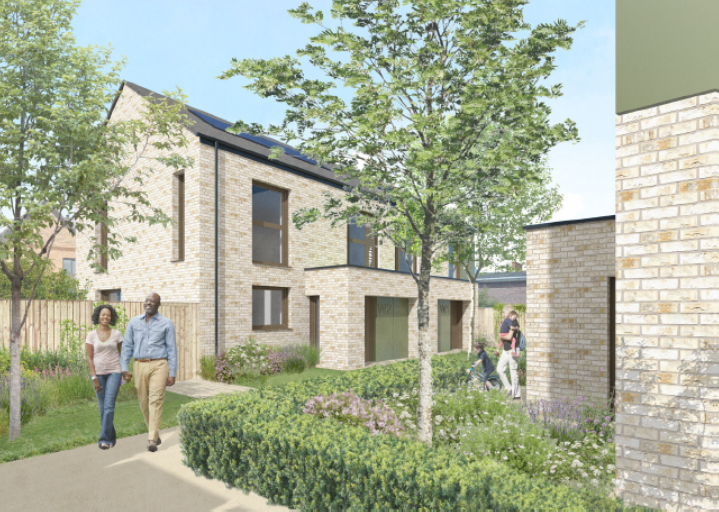
Cambridge City Council is set to deliver 90+ new council homes across six sites in the city as part of its small sites programme, following approval of new proposals and progress updates at a Cabinet meeting on 7 July.
The plans bring together proposals to build homes on three new small sites in the city, alongside updates on three existing sites already underway – potentially providing homes for at least 300 people who need them, supporting the council’s commitment to increasing the number of high-quality, sustainable council homes available in the city. Meanwhile the small sites programme provides an opportunity for local architects and builders to play a part in the council’s ambitious housebuilding programme.
The plans address a critical shortage of larger family council homes in Cambridge, with predominantly three- and four-bedroom homes proposed. Additionally, while all the council’s new homes are wheelchair accessible, at least five of these new homes would be specifically adapted for wheelchair users to live in.
It is proposed that up to 12 council homes will be built at Queen’s Meadow in Cherry Hinton. The council is purchasing the vacant Hawthorns Community Centre in King’s Hedges and plans to replace the centre with up to 30 new council homes. And around 40 new council homes are likely to replace the Horizon Resource Centre site on Coldham’s Lane, working closely with the county council which owns the centre. Cabinet also noted progress on nine new homes at sites in East Chesterton, Trumpington and Coleridge.
Cambridge’s commitment to building council homes
These six sites form part of Cambridge City Council’s ambitious housebuilding programme which has seen over 850 new council homes built since 2017, across 27 sites in Cambridge – meaning Cambridge City Council is one of the few councils in the country to actually increase its council housing stock in recent years.
Many of these have been delivered through the Cambridge Investment Partnership (CIP), the council’s housebuilding partnership with housebuilder The Hill Group established in 2017. Every new home makes a difference and these small sites also play a vital role in increasing the overall number of council homes available to those who need them in Cambridge.
Supporting housing beyond new build
Building homes is only part of what’s needed to build and support communities, and the council has also delivered five community centres, seven parks and play areas, two pre-schools, a library, new shops, and £12.2 million in funding for local infrastructure including schools, sports centres and the NHS through its housebuilding programme.
At the same meeting, Cabinet also approved plans for the council’s shared planning service with South Cambridgeshire District Council – Greater Cambridge Shared Planning – to introduce a Community Infrastructure Levy (CIL). This would enable the councils to better secure funding from other developers, to support essential infrastructure such as transport, schools, healthcare and green spaces. A ‘Charging Schedule’ will now need to be examined in public by an independent person, before being considered by both councils’ meetings of Full Council, ahead of possible implementation in early 2027.
Cabinet also approved plans to extend the council’s Homelessness and Rough Sleeping Strategy to March 2028, and accompanying Local Action Plan for the same period, which focuses on earlier prevention of homelessness, improved access to accommodation, and a reduction in rough sleeping.
Cllr Gerri Bird, Cabinet Member for Housing, said: “While the number of homes on each site is small, taken together you can see the cumulative impact they will have – 90 households who wouldn’t otherwise be able to access a comfortable council home, including at least five new homes built for wheelchair users. We believe that everyone deserves to live in a warm, safe and affordable home, and we’re doing everything in our power to make this a reality for as many people as possible.
“I’m particularly pleased that these proposals are based on finding parcels of land where buildings are not being used – such as vacant community centres – and working out how we can invest in those places resulting in an increase of 88 predominantly three- and four-bedroom council homes.
“This work forms part of a much wider programme that delivers new homes, but also investment in the infrastructure, support services and outdoor spaces that help our residents to thrive.”