We keep the city clean by removing litter and maintaining bins for litter, recycling and dog waste.
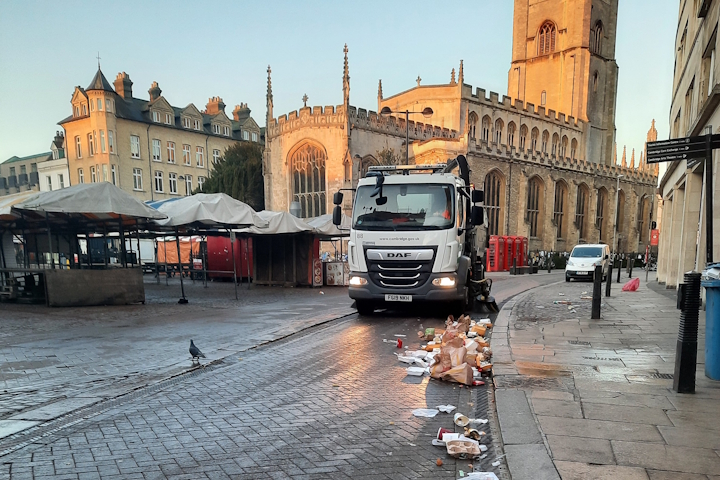
Tell us if you see a build-up of rubbish or an issue with a bin.
We are not responsible for litter or dangerous waste along the guided busway. Please report any issues on the busway to Cambridgeshire County Council.
Flytipping
Flytipping is the illegal dumping of waste. Report flytipping to us using our online form.
Dangerous litter or bodily waste
Use our online form to report needles and drug-related litter, broken glass, blood, vomit, urine or faeces.
Put your own health and safety first – do not touch the waste.
We’ll aim to respond within two hours to reports that we receive between 6am and 3pm, or as soon as possible otherwise.
We will remove dangerous litter or bodily waste from private land, but we charge to do so. Please make it clear if the waste you are reporting is on private land and provide contact details so we can arrange payment quickly.
Request a litter pick
If you see litter in a street or on a park or open space, you can ask us to clear it.
You can also ask us to collect bags of rubbish after a community litter pick.
Our form to request a litter pick is not working at the moment. Please contact us to tell us where you have seen the litter and we’ll report it for you.
Report an issue with a litter bin
We are responsible for bins for litter, recycling, and dog waste all around the city. We empty them all regularly. Tell us if you notice one that is overflowing, unclean or damaged.
If the bin is contaminated with blood, broken glass, drug-related litter, faeces, urine or vomit, or please report dangerous litter or bodily waste.
Our form to report a problem is not working at the moment. Please phone us to tell us where you have seen the problem and we’ll report it for you.
Map of bins

Litter bins

Recycling bins

Dog-waste bins
FAQs – litter bins and recycling in Cambridge
Do we recycle waste from litter bins?
Yes — where recycling bins are provided in public places. However, many standard bins are for general waste generated while you’re out and about (sometimes called “on-the-go” waste), and recycling from these bins can be contaminated with food or other non-recyclable items. Contaminated material cannot always be diverted for recycling
How is recycling sorted from litter bins?
- In city centre locations, bins are collected using vehicles that separate recycling and general waste at collection.
- In parks, residential areas and open spaces, mixed loads are taken to the Council depot where staff check clear bags for recyclable content. Contaminated material is treated as general waste.
Recycling from public bins is combined with material from community litter picks and other Council clean-up activities and is not measured independently.
Where does the waste from litter bins go?
All waste and recycling from public areas is taken to Thalia’s facility in Waterbeach for processing. The council does not comment on specific third-party processing arrangements.
How much waste and recycling is collected from litter bins?
We publish tonnage data for waste and recycling collected from public and Council-owned land. Recent tonnages:
- general waste collected from streets and public spaces in 2024/25 totalled 812.2 tonnes (combined city centre and other areas)
- recycling from the same areas in 2024/25 totalled 24.7 tonnes.
Can I request a new litter or recycling bin?
Yes. Residents can ask us to consider new bins or changes to existing bins. Requests are assessed on a case-by-case basis, taking into account:
- demand and usage in the area
- feasibility of servicing and emptying the bin
- overall impact on cleanliness and resources
As a result of these reviews, changes to locations, bin sizes and types may be made as required to improve service and efficiency.
Why might bins sometimes look full or be missing?
Bins may fill quickly in busy locations, especially at peak times.
We may review and adjust bin provision as part of service planning.
If you notice frequent overflow, damage or an issue with a particular bin, please report it to us so it can be investigated.
What happens if someone puts household or business waste in a public bin?
Public litter bins are intended for on-the-go waste — things people are carrying when out and about.
Large or repeated deposits of household or business waste may be treated as illegal dumping (fly-tipping) and could lead to enforcement action.
How can I report an issue with a litter bin or request a litter pick?
If you see a bin that is overflowing, damaged or unclean, please report it using our Report a problem with a litter bin form.
You can also report dangerous litter such as needles or hazardous waste.
Call us directly on 01223 457000 if the online forms are unavailable.
Why are litter bins not always recycled the same way as at home?
Recycling in households is collected through a structured kerbside service with clear separation and guidance.
Public litter bins are designed for convenience when out and about, and contents can vary widely.
This means recycling from litter bins often requires additional checking, and may not always be suitable for recycling due to contamination.
Why do bin liner colours sometimes vary in litter bins?
Bin liner colours may vary depending on operational need, availability and the type of activity being carried out.
The Council does not have a single, fixed policy requiring specific liner colours for all public litter bins. Liners are purchased as needed and used across a range of activities, including street cleansing, litter bin emptying, volunteer clean-ups and other waste operations.
Clear bags are often used where it helps staff visually check for recyclable material or contamination, but liner colour alone does not determine whether waste can be recycled.